

Scheduled Jobs
On this page
A scheduled execution of a notebook is referred to as a “job.
After scheduling, the job service creates a snapshot.
Create and manage scheduled jobs using the Cloud Portal or via the Management API.
Scheduled Jobs using the Cloud Portal
Create a Scheduled Job
Jobs can be scheduled for shared notebooks only.
-
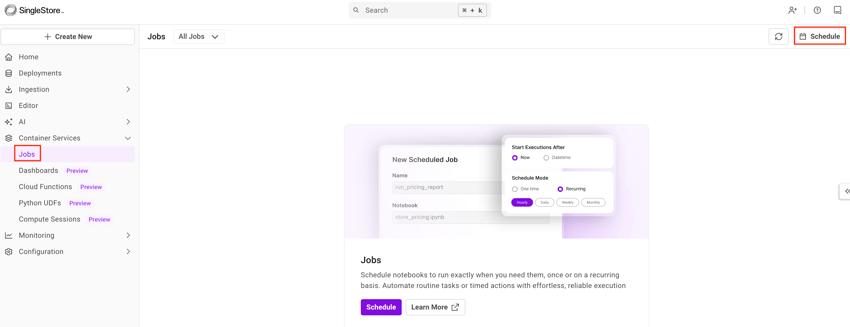
Using Jobs in the left navigation
Select Schedule (on the top right).
-
Using Shared Notebooks
-
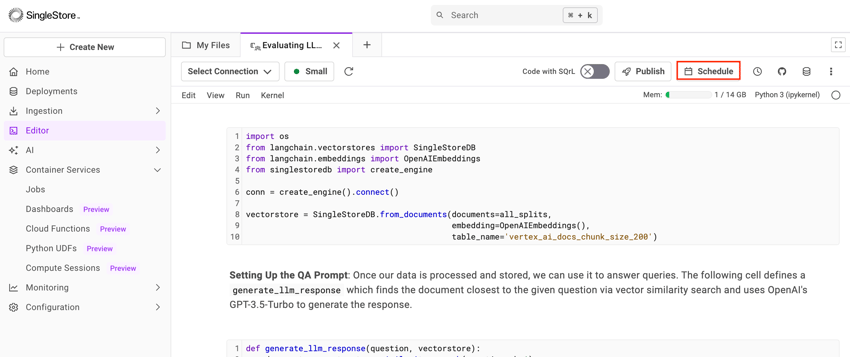
Navigate to Editor > Shared .
-
Select a shared notebook.
-
Select Schedule (on the top right).
-
New Scheduled Job
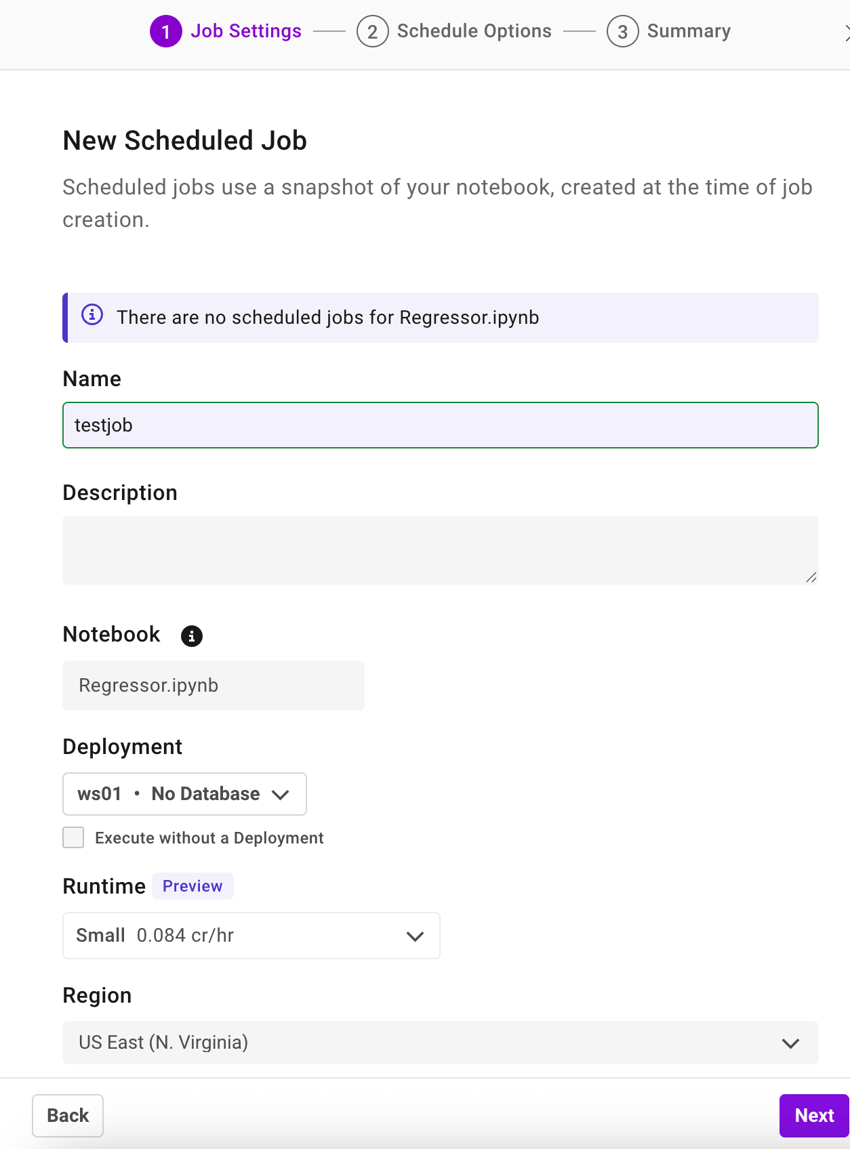
After selecting Schedule, a dialog box will appear.
Enter the Job Settings.
|
Job Settings | |
|---|---|
|
Name |
Enter a name for the job. |
|
Description |
Enter the job description. |
|
Notebook |
Select a shared notebook to run the job. |
|
Deployment |
Select the SingleStore deployment (workspace) the notebook connects to. Selecting a workspace allows connecting the SingleStore databases referenced in the notebook natively. |
|
Runtime |
Select a runtime from the following:
Note This field is in preview. |
|
Region |
Select a region. |
Select Next.
|
Scheduled Options | |
|---|---|
|
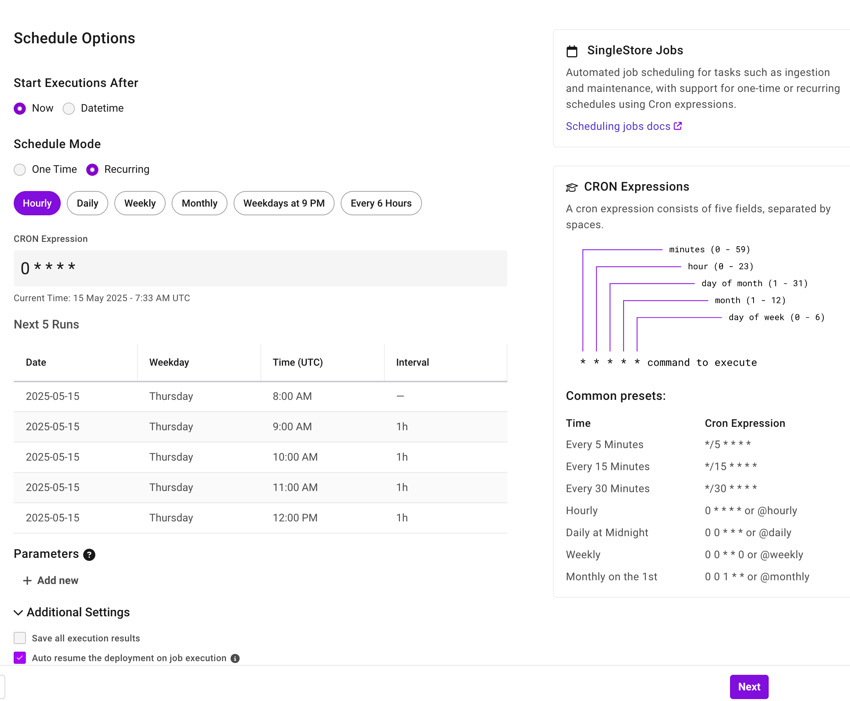
Start Executions After |
Specify the date and time for the first run of the scheduled job.
|
|
Schedule Mode |
Specify the frequency to run a scheduled job.
|
|
Parameters |
Specify the job parameters for the scheduled job.
Note The system injects parameters as Python variables into the notebook while the scheduled job runs, and access them using the variables where required. |
|
Additional Settings |
|
Select Next.
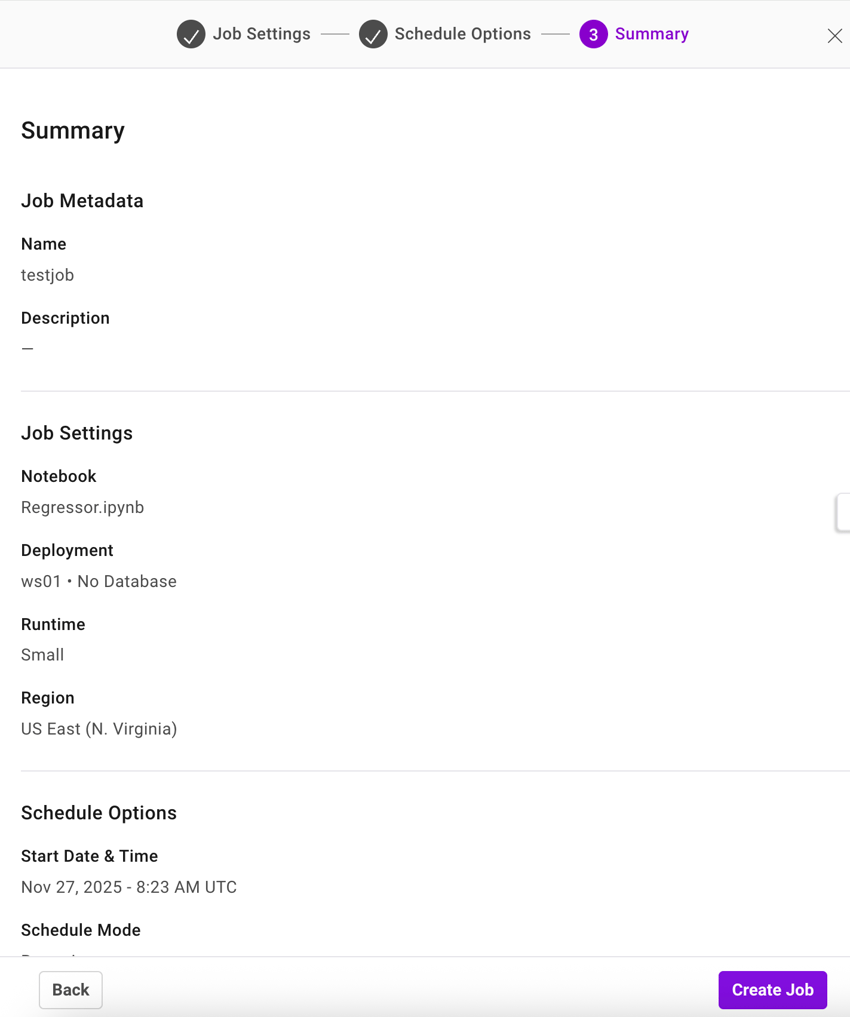
Select Create Job to schedule the job.
Manage an Existing Job
To view an existing scheduled jobs and job runs, select Jobs in the left navigation pane.
-
View
-
Edit
-
Pause
-
Resume
-
Delete
View an Existing Job
To view a job, select the job name under the Name column.
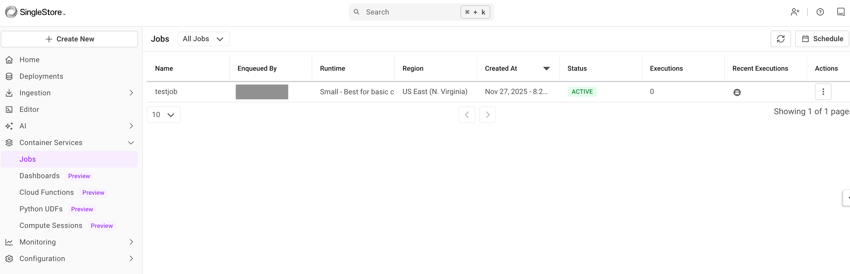
View the following job execution details for each job:
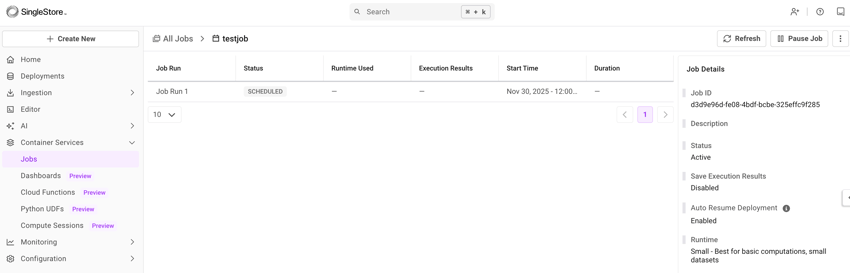
View the details of a job on the Job Details pane in the right navigation.
Edit an Existing Job
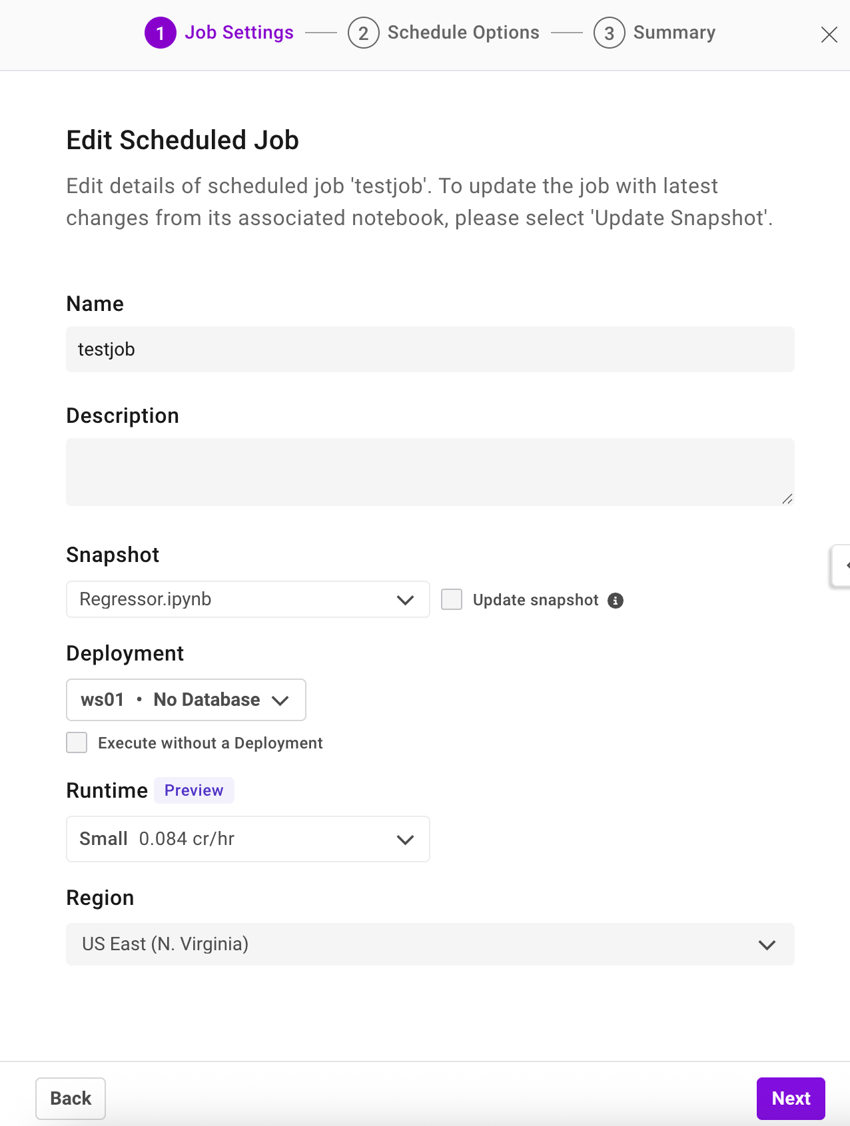
To edit an existing job, navigate to the selected job page, select the ellipsis, and select Edit Job.
Pause an Existing Job
To pause an existing job, navigate to the Jobs page, select the ellipses in the Actions column of the job, and select Pause.
Resume an Existing Job
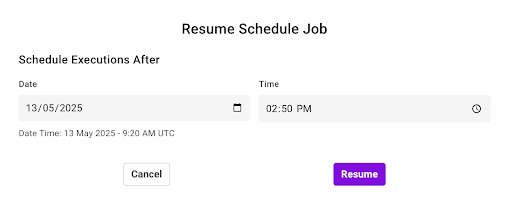
To resume an existing job, navigate to the Jobs page, select the ellipses in the Actions column of the job, and select Resume.
Delete an Existing Job
To delete an existing job, navigate to the Jobs page, select the ellipses in the Actions column of the job, and select Delete.
Warning
Deleting a job removes all associated job runs, including snapshots.
Schedule Jobs using the Management API
Use the Jobs path (/v1/jobs endpoint) to create and manage jobs using the Management API.
For example, the following API call returns information about the job with the specified jobID:
curl -X 'GET' \ 'https://api.singlestore.com/v1/jobs/7b68b78d-0000-1000-9000-0864fd331524' \ -H 'accept: application/json'Status of Job Executions
|
Status |
Description |
|---|---|
|
Scheduled |
The next scheduled run for the job. |
|
Completed |
The notebook in this job run ran to completion. |
|
Failed |
The execution failed due to user error. |
|
Error |
An error unrelated to the notebook code prevented this job from completing. |
Troubleshoot Job Runs
SingleStore automatically saves an execution result notebook of an execution that fails.
|
Error |
Solution |
|---|---|
|
Workspace Deleted |
Edit the Job and select a deployment. |
|
Workspace Suspended |
Resume the workspace, or create a new scheduled job with a different deployment. |
|
Database Detached |
Reattach the database with the right permissions or create a new scheduled job with a different database. |
|
Internal Errors / Misc |
Reach out to SingleStore Support or use the chat feature in the Cloud Portal. |
|
Notebook Timed Out |
View the snapshot to identify the cells where the notebook is timed out. Refer to Configurability and Key Considerations for the Execution Time limits set on a job run. |
|
Notebook Deleted/Not present |
Create a new scheduled job with a different notebook. |
Configurability and Key Considerations
Scheduled notebook jobs run using a snapshot of the notebook captured at the time the job is created or last refreshed.
To apply updates to a scheduled job, explicitly refresh the notebook snapshot.
An execution time limit is set for each job:
-
Maximum allowed execution duration: Specifies the maximum total time a notebook job can run, including all retries.
The job is terminated when this limit is reached, even if execution is still in progress. The maximum allowed execution duration limit is 8 hours. -
Minimum execution interval: Specifies the minimum required time interval between consecutive notebook job runs.
Schedules with intervals shorter than this limit are not allowed. The minimum execution interval limit is 60 minutes. -
Maximum execution interval: Specifies the maximum allowed time between consecutive notebook job runs.
Schedules with intervals longer than this limit are not allowed. The maximum execution interval limit is 31 days.
Examples
The following examples demonstrate how maximum allowed execution duration, minimum execution interval, and maximum execution interval are used while creating a scheduled job and how those patterns apply to scheduling notebooks within the SingleStore job service.
Example 1: Hourly Data Refresh Job
Run a notebook every hour to refresh business analytics tables.
Configuration
Cron Expression: 0 * * * *
Execution Time Limits
|
Execution Time Parameter |
Value |
|---|---|
|
Minimum execution interval |
60 minutes |
|
Maximum execution interval |
31 days |
|
Maximum allowed execution duration |
8 hours |
Behavior
This configuration allows the notebook to run once every hour, which satisfies the minimum execution interval of 60 minutes and remains within the maximum execution interval of 31 days.*/30 * * * * are not allowed.
Example 2: Monthly Compliance Report
Run a notebook once per month to generate a compliance report.
Configuration
Cron Expression: 0 0 1 * *
Execution Time Limits
|
Execution Time Parameter |
Value |
|---|---|
|
Minimum execution interval |
60 minutes |
|
Maximum execution interval |
31 days |
|
Maximum allowed execution duration |
8 hours |
Behavior
This configuration allows the notebook to run approximately once every 31 days, which satisfies both the minimum execution interval of 60 minutes and the maximum execution interval of 31 days.0 0 1 1 * are not allowed.
Last modified: March 16, 2026